
‘Dirty Boy’ Review: An Aesthetic Exploration Of Cults And Religion
Religious themes are a staple in most horror flicks, given their close ties to spirituality and otherworldly aspects. There’s a delicate balance when it comes to critically analysing cult-like behaviour within religious denominations and producing a scary movie. Doug Rao’s Dirty Boy is ambitious in its pursuit of both. Ultimately, one side proves a little more successful than the other.
★★★☆☆
Fantastically disturbing, Dirty Boy opens straight into the chaos. Trapped, alone in a room, Isaac (Stan Steinbichler) witnesses something fatally alarming. The film swiftly cuts from shrouded darkness and intense music into daylight and a beautifully scenic shot of a classical mansion. There’s an eerie religious anthem echoing from an assembled group of women as they perform a ritual to welcome Isaac back from exile. The story plays out through fragmented memories and a convoluted combination of past and present. Through both Isaac’s confused perception and an oscillating narrative that blurs the line between fiction and reality, a horrifying secret behind this makeshift family begins to reveal itself.
The feature marvels in juxtapositions, which creates an unforgivingly sinister atmosphere. Despite the cast being outfitted in Sound of Music-esque uniforms and the sights and scenes filtered with vintage warm colours, Dirty Boy is set in the present day. This detail is only made clear through occasional mentions of technology like phones and social media. This induces a suffocating timelessness, emphasising the feeling of entrapment. The cult’s central beliefs on life and death—murder and forced breeding—are equally at odds with one another.
The script is keen to stress the divide between preach and practice, constantly alluding to the cult’s hypocrisy. There are comments about the organisation’s stance as anti-drugs, yet they force Isaac to take his “pill”. In a throwaway line, Isaac questions the act of praying to God and the label of madness when claims of God speaking back to people arise. It’s all of these little inconsistencies that slowly but surely unravel the hidden darkness behind these moral-high-ground-standing figures.
Where Dirty Boy truly excels is in its use of visuals to create atmosphere and amplify the tension. The cinematography experiments with camera angles to evoke an unsettling sensation within the scenes’ visual expression. This is accompanied by strong use of lighting and colour to inject tone and highlight the synthetic feel of this ‘family’ that Isaac is a part of. The changes in lighting and colour, alongside the clever framing and use of perspective, act as physical manifestations of the divide between reality and Isaac’s struggle with mental illness. We hear narration through a voice in Isaac’s head, one that feels completely offbeat. It doesn’t come across as embedded into the video and exudes a rather otherworldly feel. The use of a CGI Jesus also adds to the overall eccentricity. This unpredictable nature of the style furthers the anxiety and distrust of those watching.
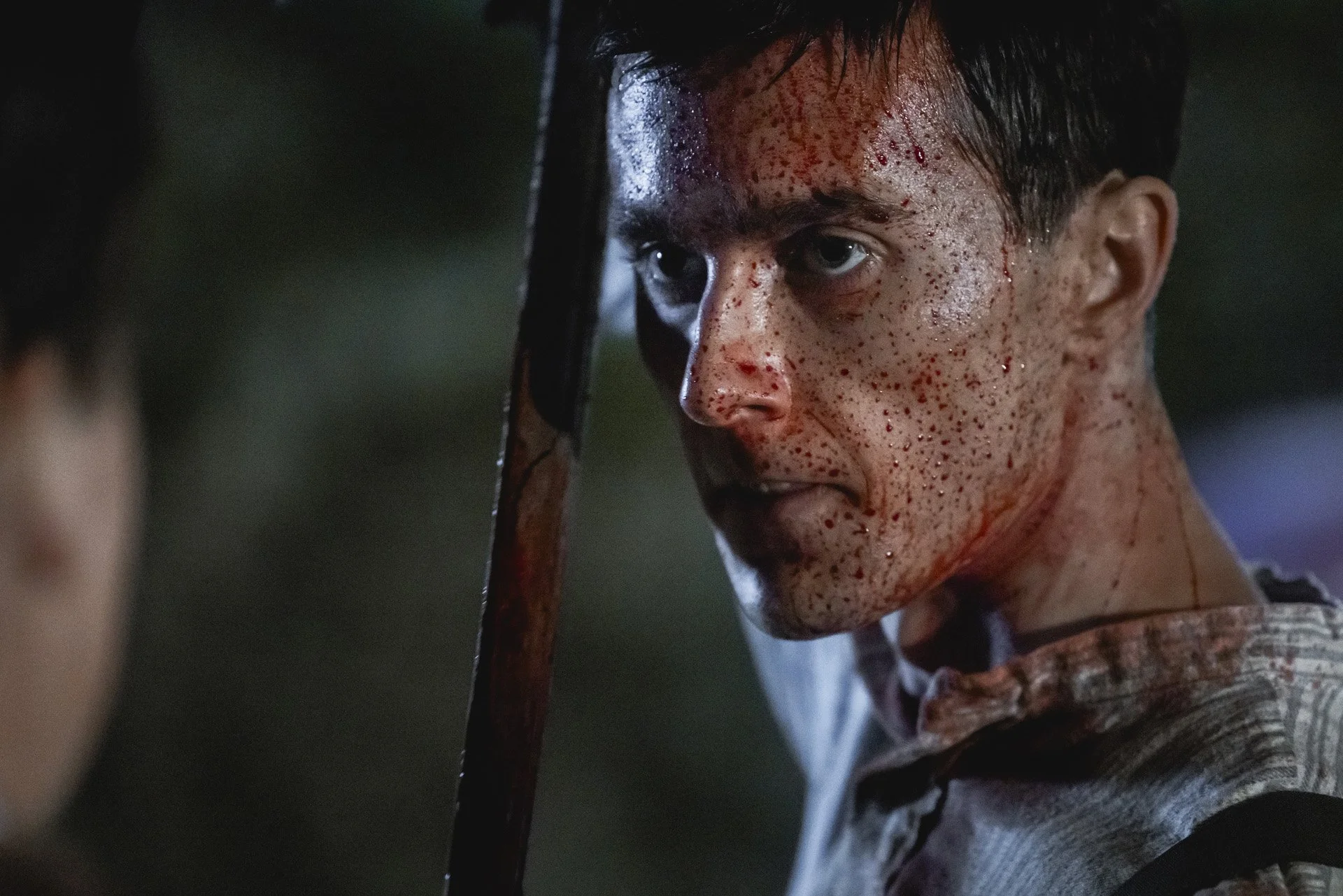
Dirty Boy (2024) © Saint Halo Productions
That said, the picture does attempt to tackle a multitude of issues. Mental health, faith manipulation, the divide between science and religion, false and predatory parental figures, and the subjugation of women within these cult-like settings are all interesting and nuanced discussions that deserve time. Unfortunately, Dirty Boy falters in its explorations, more concerned with aesthetics than analysis. It’s the same trap that haunts projects like Don’t Worry Darling (2022) and Rumours (2024). If not for the excellent performance of Steinbichler as Isaac, and the menacing figures of Graham McTavish and Susie Porter as his stand-in parental figures, Dirty Boy could flounder in its lack of coherence.
The Verdict
In terms of creep and horror factor, Dirty Boy far exceeds expectations. While it’s a premise seen and done multiple times before, and the exploration of these religious themes and their intersection with cult-like organisations isn’t detailed or groundbreaking in any sense, the combination of the visuals and the stellar acting makes for an enjoyable and intriguing watch. Its analysis of the other topics it tries to cover does ultimately fall short. Still, there is plenty of potential in Dirty Boy as a whole. Even more so, Rao astounds as a filmmaker with this fascinating debut.
Words by Mae Trumata
Dirty Boy is released in UK cinemas on 10th September and available on digital platforms from 15th October.