
‘Dirty Boy’ Review: A Fascinating Look At Mental Health And Cults
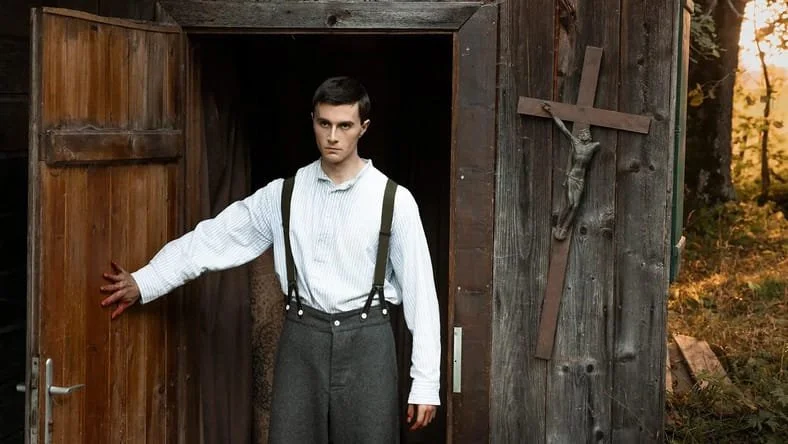
Premiering at Raindance, Doug Rao’s debut feature film opens on the titular Dirty Boy, Isaac (Stan Steinbichler), finding himself locked in his room with drug-induced amnesia. There, he must rediscover his name and why he’s being kept prisoner. But Isaac is never truly alone, because the paranoid schizophrenic has the voices in his head to keep him company. When he does escape from his bedroom with the help of fellow cult member Hope (Honor Gillies), Isaac stumbles upon a bloody sacrifice that was not meant for his eyes and realizes he can’t escape the cult he’s grown up in without first taking them down.
Isaac has gone his whole life believing he was the mad one, the dirty one in the clean, pious household. But after uncovering the cult’s bloody secret, he begins to question his own diagnosis and his upbringing. When Dirty Boy hones in on the strange religious cult, led by Walter (Graham McTavish) and Verity (Susie Porter), —who’ve adopted green juice as a daily tincture and apple cider vinegar as a cruel punishment—it succeeds in creating a distinctly creepy community even if it contains mostly borrowed ideas. Its most original concept, if an overt one, is making a conscious link between online wellness trends and rising fascism. But besides this and some well-constructed animal masks, the cult of Dirty Boy, despite being outlandish, does not stand out in the ever-expanding world of cult horror.